
Bass Lessons
Online Bass Lessons for Real Musical Growth
From solid fundamentals to advanced expression
Music Theory
Understand the structure behind the music. What you're playing and why it works.
Finger style
Develop a clean technique, strengthen control, speed, and consistency.
Odd Time Signatures
Play complex rhythms with confidence and control.
Tapping/ Slapping
Master advanced techniques to expand and develop your sound.
Bass Looping
Layer ideas into full arrangements while strengthening timing and musical awareness.
Pedals/ Effects
Shape your tone intentionally and make effects work for your playing.
Book a Free Online Bass Lesson
In this one-on-one session, we’ll assess your current level, talk through your goals, and map out a clear path forward.
You’ll get real feedback, answers to your questions, and a feel for how online lessons work.
No pressure. No commitment.
Just a focused session to see if it’s the right fit.
Meet your Bass teacher
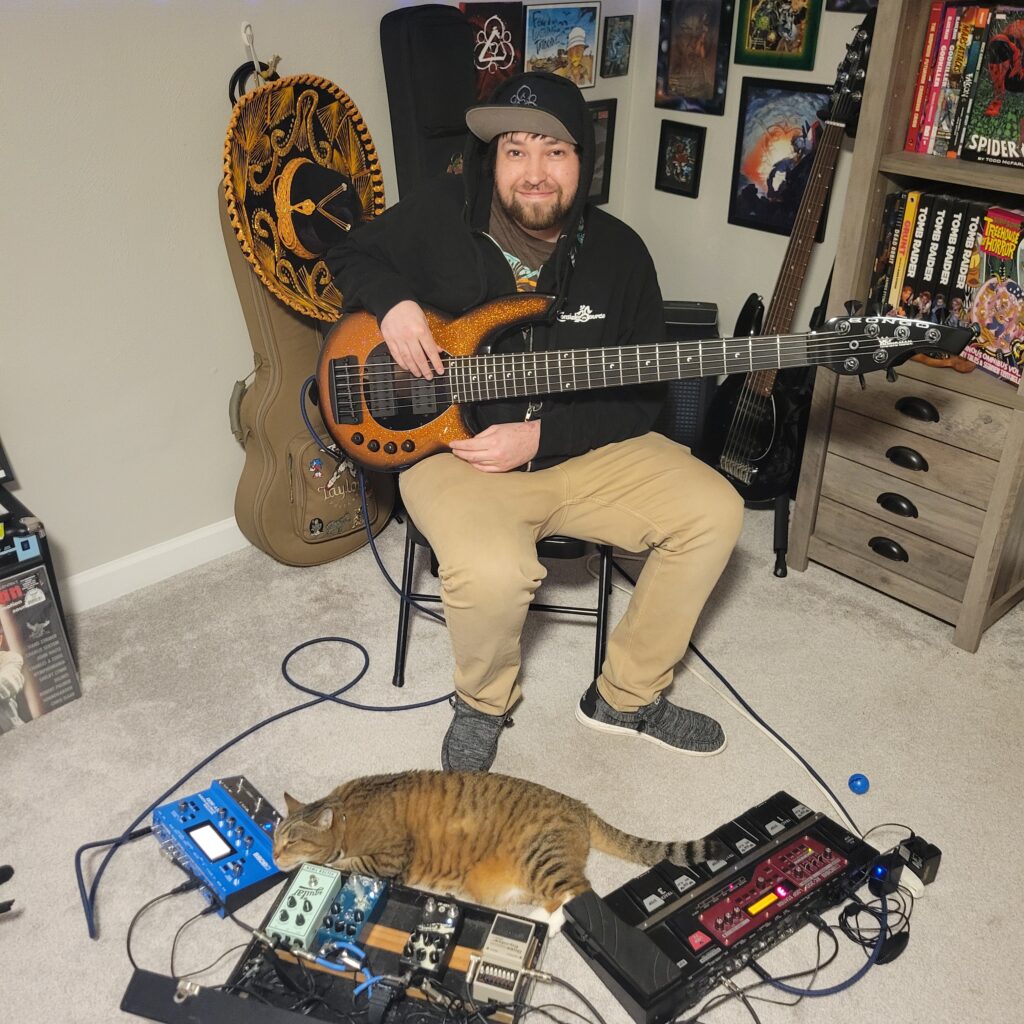
Matt Nichols
Matt Nichols has always wanted to teach bass.
As a solo instrumental bassist known as “One Man Bass Band,” he builds full, layered songs using fingerstyle, tapping, effects, and looping — turning a single bass into something much bigger than most people expect.
After years of performing and working with students of all levels, what drives him most is helping players unlock that same confidence.
His lessons are fully tailored to you — your level, your goals, and even the songs you want to learn. Whether you’re just starting out or refining advanced techniques, Matt works at your pace and helps you understand what you’re playing and why it works.
A lot of students come in unsure of what to even ask. That’s normal. Matt helps you find direction, build structure, and grow step by step — strengthening fundamentals while expanding your creativity.
Because bass isn’t just about playing root notes.
It’s an instrument with depth, melody, rhythm, and limitless potential.
And he’s here to help you explore it.
In your Bass Lessons
You'll Learn about...
Music Theory
Stop guessing
Understand the structure behind the music
What you’re playing and why it works
If you’ve ever learned a bass line from a tab and thought,
“Cool… but why does this work?”
That’s where theory comes in.
Music theory isn’t about memorizing rules.
It’s about understanding patterns. Chord construction. Intervals.
Why certain notes feel stable, and others create tension.
When you understand that, you stop hunting for notes and
start choosing them intentionally.
This is why music theory fundamentals emphasize
harmony and ear training, because
Theory is what gives you freedom.
In your lessons, we don’t study theory in isolation.
We apply it directly to the songs you’re already playing.
Scales connect to grooves. Chord tones connect
to real progressions. Every concept
shows up in actual music.
You won’t just know what to play.
You’ll know why it works.
And that changes everything.
Finger Style
Develop a clean technique
Strengthen- control, speed, and consistency
Your hands are your foundation.
Fingerstyle technique affects
tone, timing, endurance, and consistency.
If your mechanics are tense or inefficient,
everything feels harder than it should.
Even beginner guides stress the importance of
proper bass technique early on,
because bad habits compound over time.
In lessons, we focus on relaxed
hand position, alternating fingers, muting, dynamics,
and economy of motion.
The goal isn’t robotic drills,
it’s building a technique that feels natural and reliable.
When your hands are solid,
Your confidence follows.
And when your confidence grows,
Your groove improves.
Odd Time Signatures
Play complex rhythms
with confidence and control.
Most players stay comfortable in 4/4.
And that’s fine — until you want to expand.
Odd time signatures like 5/4 and 7/8 train your internal clock
in a way nothing else does.
They force you to understand subdivision.
They sharpen your rhythmic awareness.
And they dramatically
improve your feel.
Understanding how time signatures work
makes complex rhythms feel logical instead of intimidating.
In your lessons, we break odd meters into simple groupings
so they feel musical, not mathematical. You’ll learn how to count them,
phrase them naturally, and lock in without tension.
The surprising part?
Once your rhythm improves in odd meters,
your groove in 4/4 gets stronger too.
Rhythm is control
And control creates confidence.
Tapping & Slapping
Master advanced techniques to expand
and develop your sound.
These techniques aren’t just flashy.
They expand what the bass can do.
Slap adds percussive attack and funk vocabulary.
Tapping opens the door to chords, melody, and layered textures.
Together, they allow the bass to step forward,
not just sit underneath the band.
Players who shaped modern bass technique
redefined what the instrument is capable of
rhythmically and melodically.
In your lessons, these techniques are broken down step by step,
clean mechanics first, then musical application.
You’ll build clarity, timing, and control so they enhance your
sound rather than overpower it.
Technique should serve music.
Not distract from it.
Bass Looping
Layer ideas into full arrangements
while strengthening timing
and musical awareness.
Looping is one of the fastest ways to improve your timing.
Because a loop doesn’t adjust to you, you adjust to it.
When you build layered bass arrangements, you start thinking like a composer. You become aware of space, harmony, dynamics, and structure. Every overdub exposes your timing, articulation, and note length — which forces precision in the best way.
Modern players creating solo bass looping performances show how powerful one instrument can be when timing and arrangement come together.
As a solo instrumental bassist, Matt teaches you how to build grooves, chord layers, melodies, and textures,turning practice into performance.
Looping doesn’t just make you creative.
It makes you precise.
pedals & Effects
Shape your tone intentionally
and make effects work for your playing.
Effects can elevate your sound
or make it muddy fast.
Compression, octave, chorus, delay, and envelope filters.
They all change how your bass sits in a mix.
But without understanding what they’re doing,
It’s easy to overuse them.
Learning about the pedal signal chain order alone
can dramatically improve clarity and control.
In your lessons, you’ll learn how compression actually affects dynamics, how EQ changes your presence in a mix, and how to
stack effects without losing definition.
The goal isn’t to use more gear.
It’s to understand what each one is doing,
and use it with intention.
When you step on a pedal,
You’ll know exactly why.
Ready to Play With Real Confidence?
You don’t need more random videos.
You need structure, feedback, and direction.
Let’s build your skills with clarity and purpose.